
AN EMPOWER IMPACT KENYA CBO HERITAGE BOOK
The Roots of Homa Bay
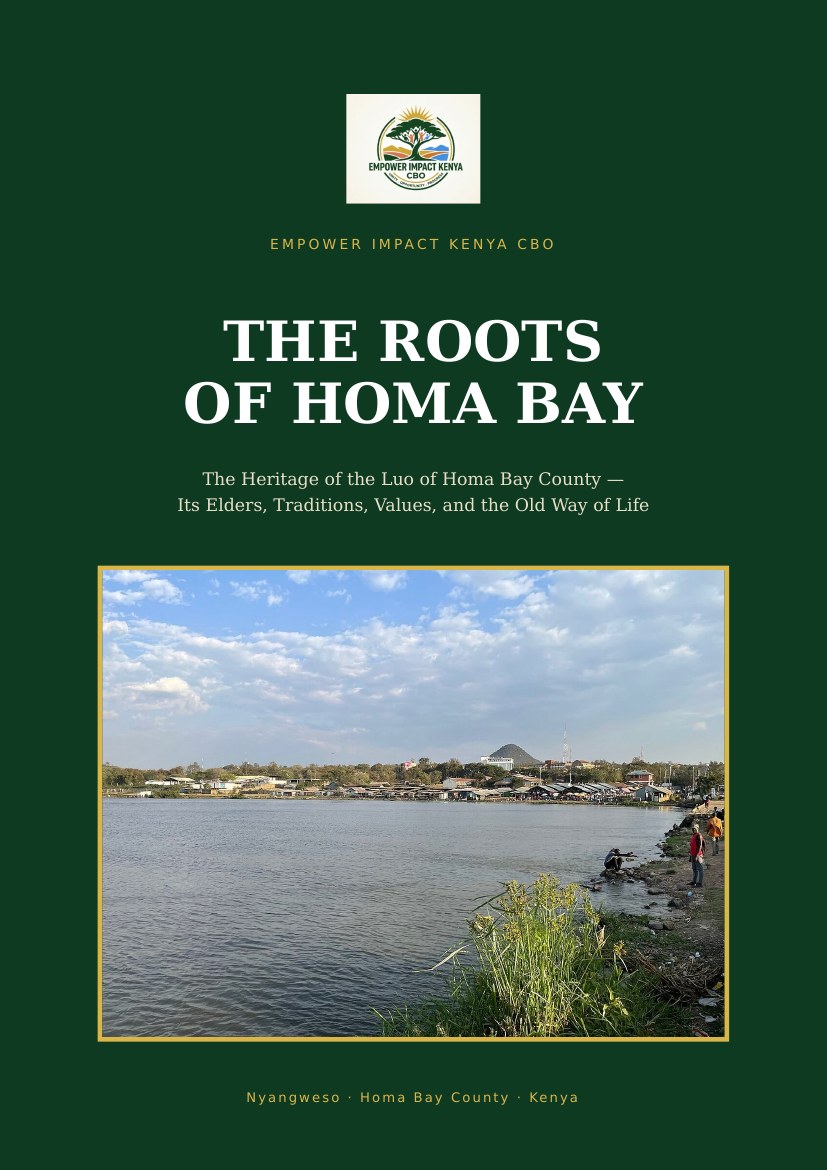
The heritage of the Luo of Homa Bay County — its elders, traditions, values, and the old way of life, gathered from the documented record so our chairman, our team, and our children can learn it, teach it, and live it.
Download the Book — Free (PDF)
Downloaded 5 times since 16 November 2026
Also shelved in the world's free library: Read it on the Internet Archive
Why This Book Exists
A man cannot teach what he does not know. A community cannot revive what it cannot remember. And a heritage that lives only in the memory of the old will leave with them when they go.
So we gathered it. Everything in this book comes from the published record — historians, scholars, missionaries, and the people's own writers — weighed honestly: what is documented is told as fact, what is the people's own story is told as their story, in its own marked panels, and what no book could verify was not invented. It was written down as a question — and the questions have their own chapter, because the elders of Nyangweso are the only press that ever printed those pages.
Read it to learn. Then close it, and go and sit with an elder. The roots of Homa Bay do not die. They only wait for rain.
Inside the Book
Part One — The Land and the People
- 1. The Deep Story: Where the Luo Came From
- 2. The Crossing of the Gulf
- 3. The Clans and Peoples of Homa Bay
- 4. The Suba: The Other First People
- 5. Sacred Geography: The Land That Remembers
Part Two — The Dala, the Elders, and the Values
- 6. The Dala: A Homestead You Could Read Like a Book
- 7. Goyo Dala: Founding a Home
- 8. The Elders: Jodongo, Councils, and Judgment
- 9. Konyir and Mutual Aid: How the Work Got Done
- 10. The Values: Kwer, Chira, and the Named Virtues
- 11. Land: Tenure, Inheritance, and What Registration Changed
Part Three — Ceremonies and Seasons
- 12. The Old Calendar: A Year Read from the Sky
- 13. Golo Kodhi: No One Sows Before His Senior
- 14. Dwoko Cham: The First-Harvest Feast
- 15. Rain and Drought: Prayer at the Shrines
- 16. The Spirit World: Nyasaye and the Juogi
- 17. When Christianity Met the Old Religion
- 18. Birth and Childhood: Entering the World in Order
- 19. Nak: The Teeth, Not the Knife
- 20. Courtship and Marriage: A Process, Not a Day
- 21. Death and Mourning: The Largest Rite of All
- 22. The Year's Gatherings
Part Four — The Century
- 23. The Colonial Order, 1895–1963
- 24. The Luo Union: The People Organize Themselves
- 25. Two Sons of the Soil: Gor Mahia and Tom Mboya
- 26. Independence to Today, 1963–2026
- 27. A Century of Daily Life
Part Five — The Voice, the Dress, and the Table
- 28. The Proverbs: The Wisdom of the Fireside
- 29. Phrases and Language: The Tongue of the Book
- 30. Sigendini: The Evening School of Stories
- 31. Music and Dance: The Sound of the People
- 32. Dress and Adornment: What the Body Wore
- 33. The Table: Kuon, the Grains, and the Law of Sharing
- 34. The Lake's Law: Fishing Traditions
- 35. Crafts: The Work of Hands
Closing
- 36. What Was Lost, What Can Return
- 37. Questions Only Our Elders Can Answer
Plus a Foreword, a guide to reading the book, full Sources, and Photograph Credits.
A Living Book — Help Us Finish It
The last chapter of the book is Questions Only Our Elders Can Answer — the founding of Nyangweso, the work parties as this village kept them, the famine years and their names, the words said over the first harvest. If you are an elder, or your family holds a story, a name, or a correction, we want the next edition to carry it.
Share it with us on WhatsApp: +254 701 917972 — your first name and village, and please tell us clearly if we may print it. Honor first, always: nothing is published without the teller's permission.
THE 1,000 PROVERBS PROJECT
99
of 1,000 proverbs gathered
Help Us Save Them Before They Are Lost
This book holds 99 Luo proverbs. Our elders hold hundreds more — and every year, some are lost forever. Send us the proverb your grandmother taught you, and it will be counted, credited to you, and carried into the next book: THE 1,000 PROVERBS.
Text or voice note · +254 701 917972 · Tell us your first name, your town, and who taught you — every carrier is thanked and named, with permission.
A TRIBUTE TO OUR ROOTS — AND A LEGACY THAT WILL OUTLIVE US
On 21 November 2026, the proverbs of our elders took their place on Wikiquote, the world's free quotation encyclopedia and the companion of Wikipedia. The page — Luo proverbs — is the first of its kind: twenty-five proverbs in Dholuo, each with its translation and its meaning, carried in our book The Roots of Homa Bay, which stands cited there as the source.
We did not do this for applause. We did it as a tribute — to the grandmothers who taught in the siwindhe, to the elders whose memories are living libraries, and to every carrier who kept these sayings alive by word of mouth alone. And we did it as a legacy. Hosting ends and accounts close, but a page on the world's encyclopedia endures. Long after us, a student, a teacher, or a child of the diaspora searching for the wisdom of home will find these words still standing — and the road back to Nyangweso with them.
This is why we published our book, and gave it to the whole world free. And this is why the work goes on: the 1,000 Proverbs Project is gathering the rest, before they are lost.
Riwruok e teko — unity is strength.