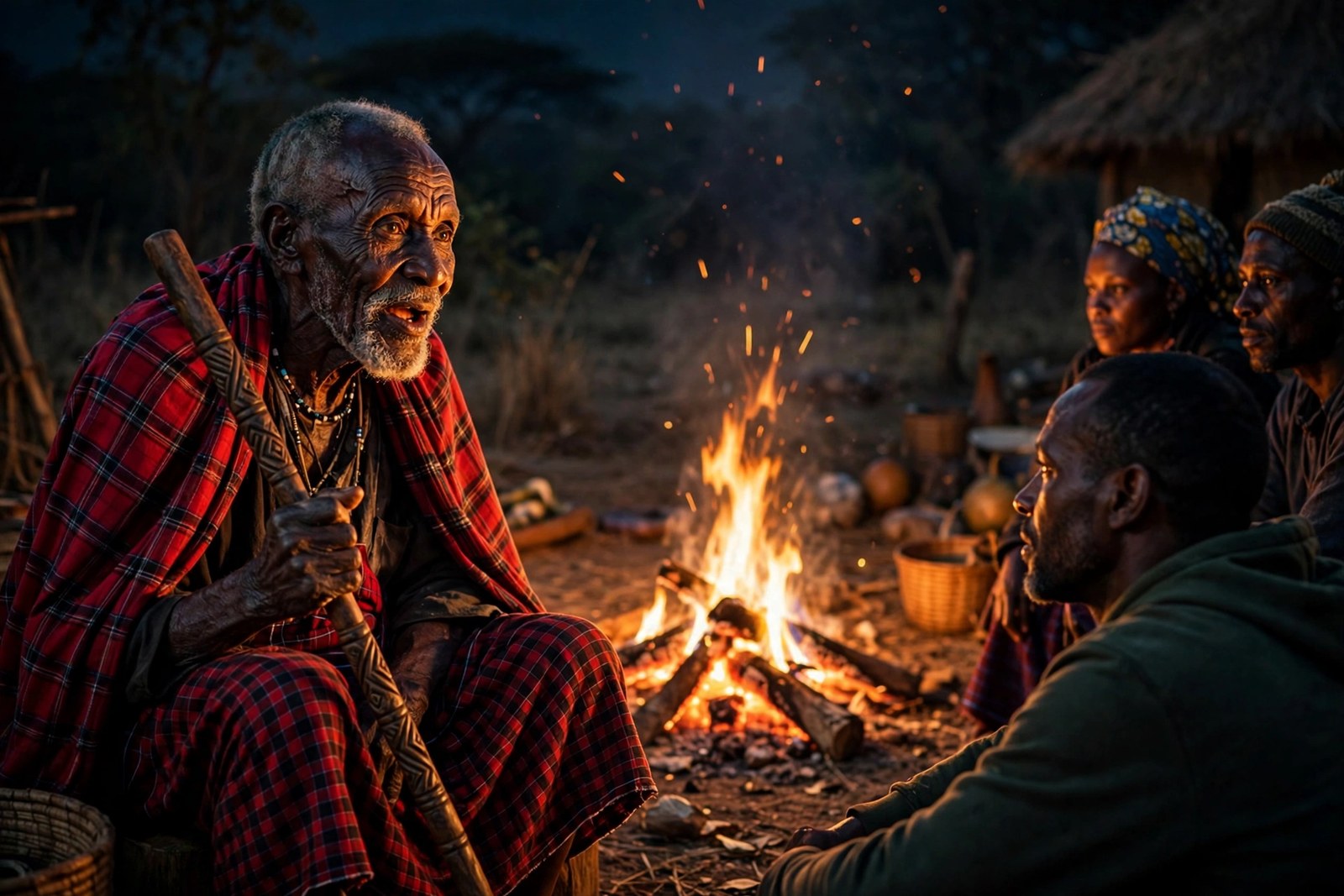
Dho Luo — the language of the lake shore. Learn to greet us in it, and sit a while with the ngeche, the proverbs in which our elders keep a whole people's wisdom.
Dholuo is the language of the Luo people of western Kenya and northern Tanzania, spoken all around the eastern shores of the lake we call Nam Lolwe — Lake Victoria. It belongs to the Western Nilotic family, kin to Acholi, Alur and Lango across the border in Uganda. It is a tonal language — the same word can change its meaning with its music — and it is learned the old way first: at home, in the homestead, in stories and songs and proverbs around the fire.
A written tradition came later: the first Dholuo grammar was published in 1910, and the scholar Asenath Bole Odaga of Kisumu gave the language its great dictionaries and its beloved collections of proverbs and sayings. Today Dholuo is spoken by more than four million people, heard on Ramogi TV and KBC, sung in church — the Bible itself circulates in Dholuo — and spoken every day in the homes, markets and beaches of Homa Bay.
Try these at the gate of any dala in Homa Bay, and watch the faces light up:
And the everyday words of the shore: ber — good · rech — fish · nam — lake · pi — water · kuon — ugali · chiemo — food · dhiang' — cattle · nyathi — child · dichuo — man · dhako — woman · kwaro — grandfather · dayo — grandmother · wer — song · mach — fire · koth — rain · chieng' — sun.
Dho Luo taught the old way — mouth to ear, in the voice of Liech, our CBO mascot.
Press play and let Liech welcome you to the schoolroom — then work through the lessons below, one word at a time. In every lesson she reads the words slowly, with their meanings, and leaves you room to answer.
Every word here carries its spelling, a say-it guide for new tongues, and her voice speaking it aloud. Our spellings follow the standard written Dholuo — the dictionaries of Asenath Bole Odaga and the phrase collections this house already trusts. The say-it guides are helps; the voice is the true teacher. And the elders of home check this room as they check everything here — if your dala says a word another way, tell us on WhatsApp. The house learns too.
Dholuo is written the way it sounds — every letter is spoken. Only a few letters need a guide:
Dholuo is also a tonal language — the same letters can change their meaning with their music. That is one more reason the ear learns what the eye cannot: press play, and copy her.
Try these at the gate of any dala in Homa Bay, and watch the faces light up.
The first thing every child learns. Clap along with Liech, the way the little ones do in the Kids Corner.
Say them: ah-CHEE-el · ah-REE-yoh · ah-DEK · ah-NGWEN · ah-BEECH · ow-CHEE-el · ah-bee-REE-yoh · ah-BOH-roh · oh-CHEE-koh · ah-PAHR.
The people of the dala — begin with the grandparents, the way respect begins.
The creatures of the lake and the land — including the whole Storytellers’ Circle.
The words of home and of the shared table.
The words this house lives by — hear them slowly, and carry them gently.
Whole phrases now — the ones that open doors and hearts.
Short video lessons are being prepared for this room — Liech teaching the greetings face to face, the way she teaches in the Kids Corner. Until they land, the voice lessons above are the way in: listen, speak, repeat. The little ones can start today in the Kids Corner (Age 3–7), and the older ones climb the Luo Ladder in the Young Root Keepers (Age 7–14).
Luo proverbs, sayings and riddles are known together as ngeche (one is a ngero). A ngero is more than a proverb: it is a small, complete piece of social wisdom whose full meaning unfolds from the moment it is spoken into. The elders are its chief carriers — a well-placed ngero from an elder can settle an argument the way a judge's ruling does, teaching and correcting without ever raising a voice. Children meet the ngeche first as riddles and fireside fun, and absorb the moral code of the people inside the laughter.
Every home in Homa Bay has two voices. At the fireside we speak Dholuo, the language of our grandmothers. But step into the market, the school, the bus stage or the county office, and another language carries us: Kiswahili — the language in which a Luo greets a Kikuyu, a Luhya, a Maasai and a coastal neighbour, and understands, and is understood.
Kiswahili was born on the shores of the Indian Ocean. Its very name comes from the Arabic word sawahil — “the coasts.” It grew from the Bantu languages of the coastal peoples, and over a thousand years of trade the dhows brought Arabic words into it the way the lake brings fish to the shore — naturally, and in plenty. It was first written in Arabic letters; today it is written in the Latin letters you are reading now.
From the coast, the traders carried it inland, town by town, until it became the linking language of all East Africa. Today it is Kenya’s national language, spoken beside English in her schools and her Parliament, and understood from Lamu to Busia and far beyond — well over a hundred million voices. In Homa Bay it does not replace Dholuo. It stands beside it, the way a neighbour stands beside a neighbour.
Kenya’s national motto is one Kiswahili word: Harambee — the cry of people hauling a boat ashore or raising a roof together: all pull together! At this house it needs no translation, for Dholuo has been saying it all along: Riwruok e teko — unity is strength. Two languages, one heartbeat.
Every language keeps its wisdom in small bundles. Here are the methali — the proverbs of Kiswahili — carried the way our own ngeche are carried: mouth to ear, heart to heart. Listen for the first one: it is the twin brother of our own Riwruok e teko.
The elders are gathering 1,000 Luo proverbs before they are lost — every ngero carried to us is written into the Register, checked, and credited to its carrier. If your grandfather holds one we have not written down, bring it home: WhatsApp text or voice note to +254 701 917972.