No. 1
Kogno achiel ok neg onyuogo.
"One thumb does not crush a louse."
The MeaningJoint effort is called for. Odaga's own gloss: "Unity is strength" — the proverb to set beside the phrase riwruok e teko
Hear it spoken
EMPOWER IMPACT KENYA CBO · FROM THE ROOTS OF HOMA BAY
The wisdom of the fireside, open to everyone: 120 proverbs and sayings of the Luo people, in Dholuo, with their English translations and meanings — gathered in our free book so they will never be lost. Read them, search them, share them, teach them.
Know a Luo proverb we have not gathered yet? Send it to us — by WhatsApp on +254 701 917972, or by email to info@empowercbo.com (voice notes welcome). Every proverb is credited to its carrier, with permission.
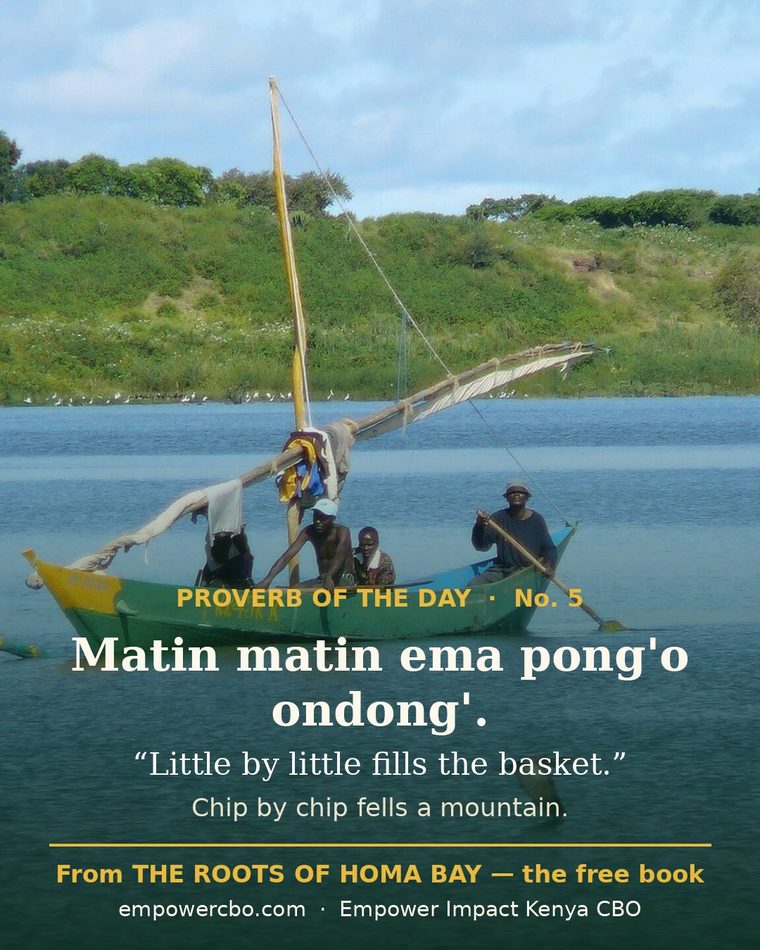
Matin matin ema pong'o ondong'. “Little by little fills the basket.” Meaning: Chip by chip fells a mountain.
Hear it spoken
Today's spoken proverb arrives with the morning.
A new proverb is spoken aloud here every day. Come back tomorrow and listen again.
Showing 120 of 120
No. 1
Kogno achiel ok neg onyuogo.
"One thumb does not crush a louse."
The MeaningJoint effort is called for. Odaga's own gloss: "Unity is strength" — the proverb to set beside the phrase riwruok e teko
Hear it spoken
No. 2
Ng'at achiel ok yie tat dero.
"One person alone cannot put a roof on the granary."
The MeaningSome tasks call for joint effort; nobody roofs the dero
Hear it spoken
No. 3
Ithanyri ka yap ng'at achiel
"As shallow as one man's pond."
The MeaningOne person's effort makes only a shallow pond; in certain instances joint effort creates the better impact. (Odaga no. 225; also recorded as Othanyore ka yap ng'at achiel
Hear it spoken
No. 4
Kata iriek ok inyal lielo wiyi kendi.
"No matter how accomplished a person is, he cannot shave his own hair."
The MeaningEveryone needs others.
Hear it spoken
No. 5
Kitembe notamo ruoth.
"Even the chief did not own kitembe seeds."
The MeaningNo person, not even a chief, is totally self-sufficient.
Hear it spoken
No. 6
Loch noloyo Ngadi.
"Even chief Ngadi lacked something."
The MeaningNo person can have everything; we depend on each other.
Hear it spoken
No. 7
Goyo bat piny.
"To bring the arm down."
The MeaningTo surrender a quarrel, compromise, and accept to work together.
Hear it spoken
No. 8
Ber wuotho gi jating' kom kata ja kol kudho.
"It is good to travel with a stool-carrier, a companion who can also extract a thorn from your foot."
The MeaningNo one is an island; no one is self-sufficient.
Hear it spoken
No. 9
Gode ok rom, dhano to rom.
"Hills never meet, but human beings do."
The MeaningDeal carefully with others; one day you may need their help.
Hear it spoken
No. 10
Oyieyo mathoth ok kuny bur.
"Many rats do not dig a hole."
The MeaningThe counterweight: many cooks spoil the broth. Togetherness works when it is organized, not when responsibility is diffused.
Hear it spoken
No. 11
Ok inyal puonjo dani madho kwesi.
"You cannot teach your grandmother how to smoke a pipe."
The MeaningAge brings wisdom and knowledge through experience.
Hear it spoken
No. 12
Nyathi ok bed e kom kama jomadongo nitie.
"A child does not sit on a stool at a meeting where older men are meeting."
The MeaningAge brings respect and wisdom; the young take their proper place and listen.
Hear it spoken
No. 13
Ru ruath e mewone.
"The longer a bull lives, the fatter it becomes."
The MeaningAge is experience; wisdom grows with age.
Hear it spoken
No. 14
Jowi mager ema ichuogo piene.
"It is the fierce buffalo whose skin makes the crescent shield."
The MeaningThe experienced, battle-tested elder's advice is the advice sought when there is a problem.
Hear it spoken
No. 15
Iming' ka mane ok oninde siwindhe.
"As ignorant as a person who never slept in the siwindhe."
The MeaningOdaga's own explanation: the siwindhe
Hear it spoken
No. 16
Dhano ipuonjo nyaka tho.
"A person is taught until death."
The MeaningLearning never ends, not even for the old.
Hear it spoken
No. 17
Tin ok en fuwo.
"Youth is not stupidity or ignorance."
The MeaningThe balance to all the above: even a young person may have something to teach an older person.
Hear it spoken
No. 18
Geno lep Nyakeno.
From the custom that the tongue of a slaughtered animal is always for the old men: Nyakeno expected the tongue, and his wife had eaten it.
The MeaningRespect is not only spoken; it is served, in meat — a saying the chapter on the table will meet again.
Hear it spoken
No. 19
Kinda e teko.
"Perseverance is strength."
The MeaningThe whole ethic of work in three words.
Hear it spoken
No. 20
Kinda e loyo lweny.
"Perseverance is victory."
The MeaningEndurance, not force, wins the fight.
Hear it spoken
No. 21
Kinda ne omiyo opuk oyombo apuoyo.
"Perseverance made the tortoise beat the hare."
The MeaningThe tortoise-and-hare tale in one line; drop by drop fills the bucket.
Hear it spoken
No. 22
Jakinda ema keyo.
"The person who perseveres is the one who harvests."
The MeaningThe harvest belongs to the one who stayed.
Hear it spoken
No. 23
Kich ithodho to kecho.
"Honey is harvested while the bees are stinging."
The MeaningSuccess comes with hard work and perseverance; sweetness is not gathered without pain.
Hear it spoken
No. 24
Chung'ni ok miyi.
"Standing still, doing nothing, does not feed you."
The MeaningYour effort is what pays.
Hear it spoken
No. 25
Chamo to e timo.
"Eating is not doing."
The MeaningIt is easier to eat served food than to work for it.
Hear it spoken
No. 26
Gima ichuoyo ema ikayo.
"What you sow is what you reap."
The MeaningEffort determines the life one leads.
Hear it spoken
No. 27
Luchi ema ichamo.
"It is your own sweat that you eat."
The MeaningYou live by what your own effort produces.
Hear it spoken
No. 28
Giri ema chodi luya.
"It is your own possession that makes you sweat."
The MeaningAchievement through one's own sweat gives satisfaction.
Hear it spoken
No. 29
Monjo rapur.
"Whoever tills the land does not come out with nothing."
The MeaningNo hard work is without positive result.
Hear it spoken
No. 30
Ng'ama dwaro ema yudo.
"It is the one who searches who finds."
The MeaningEffort, hard work and perseverance are rewarded.
Hear it spoken
No. 31
Matin matin ema pong'o ondong'.
"Little by little fills the ondong' (the small measuring basket)."
The MeaningChip by chip fells a mountain.
Hear it spoken
No. 32
Mbaka nyapong' gi dero.
"The contest between the grinding stone and the granary."
The MeaningThe small stone grinds a little grain at a time until it has ground all that is in the dero
Hear it spoken
No. 33
Chako chon loyo dhi ajuoga.
"Beginning early is better than going to the medicine man."
The MeaningPrevention is better than cure; start in good time.
Hear it spoken
No. 34
Agulu mi rito ok yieny.
"A pot that is being waited for takes long to boil."
The MeaningAnxiety stretches time; patience.
Hear it spoken
No. 35
Bed mos pod ok ineno kang' eyi.
"Be patient; you have not yet seen your back."
The MeaningA caution to youth: to "see your back" is to have children of your own; experience comes only through life's hurdles.
Hear it spoken
No. 36
Chuny teko loyo rikni.
"A strong, calm heart is better than hastiness."
The MeaningPerseverance and calmness beat hurry.
Hear it spoken
No. 37
Jarikni ja a nono.
"A person ever in a hurry gets away with nothing."
The MeaningSlow but sure wins the race.
Hear it spoken
No. 38
Ja rikni ja muod nyoyo gi kuoyo.
"The ever-hurrying person eats his maize-and-beans with grit in it."
The MeaningHurry, hurry has no blessing.
Hear it spoken
No. 39
Mos mos e wuoth.
"Slowly, slowly is the journey."
The MeaningSlow but sure.
Hear it spoken
No. 40
Luw mabor to ichopi.
"Follow the longer route and you will arrive safely."
The MeaningTake time for lasting solutions rather than hurried decisions.
Hear it spoken
No. 41
Maliet ema kwe.
"That which is hot cools off."
The MeaningNothing lasts forever; be patient.
Hear it spoken
No. 42
De nyuok.
"Strangle a he-goat."
The MeaningBe brave, be patient, persevere — the he-goat is the byword for stubborn endurance.
Hear it spoken
No. 43
Adier en kwiri.
"Truth is poisonous."
The MeaningTruth kills falsehood.
Hear it spoken
No. 44
Adiera ok tow.
"Truth does not rot."
The MeaningThe truth always remains true.
Hear it spoken
No. 45
Adiera ok um.
"Truth cannot be covered."
The MeaningSpeak the truth and shame the devil.
Hear it spoken
No. 46
Dhok e tung dhano.
"The mouth is a human being's horn."
The MeaningAnimals defend themselves with horns; human beings defend themselves with speech.
Hear it spoken
No. 47
Wach loyo bul gi long'o.
"The word travels further than the sound of the drum."
The MeaningThe spoken word is more powerful than the drum.
Hear it spoken
No. 48
Wacho ok e timo.
"Saying is not doing."
The MeaningAction speaks louder than words.
Hear it spoken
No. 49
Lewi bith ka opila.
"Your tongue is as sharp as a peel from maize, sorghum or sugarcane stem."
The MeaningWords have sharp edges; be careful what you say.
Hear it spoken
No. 50
Lewi eno jiemni.
"Your tongue may bring calamity on you."
The MeaningA caution to the tactless talker.
Hear it spoken
No. 51
Dhogi no jemni.
"Your mouth will put you in problems."
The MeaningBe careful with your utterances.
Hear it spoken
No. 52
Ling' loyo duoko.
"Silence is better than giving a reply."
The MeaningNot every word spoken to you deserves an answer.
Hear it spoken
No. 53
Ling' chiko it en ohala.
"Listening carefully is beneficial."
The MeaningA good listener learns many new things.
Hear it spoken
No. 54
Keto jadiemre.
"Observe carefully, quietly."
The MeaningAt times, think and observe without talking; silence is gold.
Hear it spoken
No. 55
Ka idwaro pimo wach maling'ling' to kik ipim ei ot.
"If you want to divulge a secret, do not do it inside a house."
The MeaningWalls have ears.
Hear it spoken
No. 56
Beduru motang' hundhwe ni machiegni.
"Be watchful; the hundhwe (the talking bird) is near."
The MeaningNothing said in private is guaranteed secret.
Hear it spoken
No. 57
Elo winyo e iro.
"Uncover a bird in a smoky place."
The MeaningReveal a secret near a gossip and it spreads like smoke.
Hear it spoken
No. 58
Awinjo awinja loyo ng'ama oaye.
"Hearsay claims to know more than the eyewitness."
The MeaningRumor is more sensational than truth.
Hear it spoken
No. 59
Iro ok dum nono ma onge mach.
"There is no smoke without fire."
The MeaningA rumor must have a source.
Hear it spoken
No. 60
Rit iwach kineno.
"Wait and talk when you have witnessed something."
The MeaningBe cautious in reporting hearsay.
Hear it spoken
No. 61
Akuru ok kuodhi e iro.
"A dove is not backbitten in a smoky place."
The MeaningSerious and valuable matters are not discussed carelessly in the open.
Hear it spoken
No. 62
Jabudho e duonde ariyo jabedo jamiriambo.
"A member of two evening fireside gatherings (two duol clubs) is likely to be a liar."
The MeaningOne cannot serve two masters faithfully; the saying also preserves the duol
Hear it spoken
No. 63
Acham ayieng' ne onego suna.
"'I eat until I am satisfied' killed the mosquito."
The MeaningGreed kills.
Hear it spoken
No. 64
Ich lach nonego Okal Tako.
"Covetousness killed Okal Tako."
The MeaningUncontrolled greed may prove fatal.
Hear it spoken
No. 65
Dhako ema kelo mwandu.
"It is a wife who creates wealth."
The MeaningA wife is a harbinger of wealth.
Hear it spoken
No. 66
Lwete ber.
"Good hands."
The MeaningSaid of one who knows how to create wealth; whatever he touches multiplies, in livestock and in crops.
Hear it spoken
No. 67
Lwete bup.
"His hands are heavy."
The MeaningHe is generous; his hands are heavy with giving.
Hear it spoken
No. 68
Chunyi ler ka ndara.
"You are as clean-hearted as the road."
The MeaningSaid of someone generous and welcoming to everyone who passes.
Hear it spoken
No. 69
Ero en sombe koso soko.
"It takes away or refills like a well."
The MeaningEven a well may dry up; use every resource carefully.
Hear it spoken
No. 70
Otonglo nonego otondi nyar Seme.
"Ten cents killed Otondi, the girl from Seme."
The MeaningLove of materialism may cause death.
Hear it spoken
No. 71
Dhier kiyombi.
"Poverty cannot be left behind."
The MeaningNeed is never fully escaped; it walks with a person.
Hear it spoken
No. 72
Guok ong'iyo kama omuode chogo.
"A dog frequents the place where it gets a bone to chew."
The MeaningKindness is paid with kindness.
Hear it spoken
No. 73
Adita mipime ema ipimonie.
"The measure you use is the measure used to repay you."
The MeaningMeasure for measure.
Hear it spoken
No. 74
Tho mariwa.
"In death all human beings are equal."
The MeaningDeath is the great equalizer.
Hear it spoken
No. 75
Dhiang' tho gi lum e dhoge.
"A cow dies with grass in its mouth."
The MeaningDeath allows no time to prepare.
Hear it spoken
No. 76
Ondamo minyono ema teri kaliel.
"Every step you take draws you nearer to your grave."
The MeaningEvery beginning has an end.
Hear it spoken
No. 77
Nindo nyamin tho.
"Sleep is death's sister."
The MeaningIn sleep, as in death, one is oblivious to the world.
Hear it spoken
No. 78
Ich ema ithogo.
"It is your stomach with which you die."
The MeaningWhen we die, all we have remains behind except what we have eaten.
Hear it spoken
No. 79
Bur achiel ok ike ji ariyo.
"Two people are not buried in one grave."
The MeaningNo two people are totally alike; each meets death as himself.
Hear it spoken
No. 80
Jaote tho ok geng'.
"Death's messenger is not stopped."
The MeaningNo one argues with the summons.
Hear it spoken
No. 81
Ji ok tho duto.
"People do not all perish at the same time."
The MeaningEven in disaster there are survivors.
Hear it spoken
No. 82
Yie ok neg ji duto.
"When a boat capsizes, not all its occupants drown."
The MeaningIn most disasters there are survivors — a lake people's hope, and the lake's chapter will return to it.
Hear it spoken
No. 83
Winyo bende uyo ka aye to piyo.
"Even a bird flies, and in the end lands somewhere."
The MeaningEverything has its end.
Hear it spoken
No. 84
Tham oyieyi.
"Tham (God) favors you; Tham agrees with you."
The MeaningTham
Hear it spoken
No. 85
Ka Nyasachi pod nitie to kata kingi to kadho akadha.
"While your God is still with you, even if you are bewitched, the bad magic will not harm you."
The MeaningA person's life is controlled by his God, his luck or fate, not by another human being. Nyasaye/Nyasachi
Hear it spoken
No. 86
Chien kiyany.
"One's background and origin are never insulted."
The MeaningOne's beginning makes one what one is; respect it.
Hear it spoken
No. 87
Dalau ok rwenyi.
"You cannot fail to recognize your home."
The MeaningHowever far a man travels, home is known on sight.
Hear it spoken
No. 88
Ruoth ok yiere e kom kende.
"A chief does not elect himself."
The MeaningA good leader does not impose himself on the people.
Hear it spoken
No. 89
Kul ma ruedhi iye roye ok ponie.
"Calves do not thrive in a cowshed where bulls always fight."
The MeaningWhen two leaders fight, those under them suffer most.
Hear it spoken
No. 90
Apuoyo nindo to neno.
"The hare sleeps with its eyes open."
The MeaningAlways alert.
Hear it spoken
No. 91
Apuoyo tin to go rude.
"Although small, the hare produces twins."
The MeaningSize does not limit ability.
Hear it spoken
No. 92
Apuoyo tho e gonde.
"The hare dies in its lair."
The MeaningIn attack, one runs home to safety.
Hear it spoken
No. 93
Apuoyo ok tony e oro ariyo.
"The hare does not escape the snare in two consecutive droughts."
The MeaningA thief's days are numbered.
Hear it spoken
No. 94
Abet e kombe adek kinde duto.
"I always sit on three chairs."
The Answera cooking pot resting on three stones.
Hear it spoken
No. 95
Kombe adek ma ka achiel onge to ariyo modong' ok ti.
"Three chairs; if one is missing, the other two cannot work."
The Answerthe three cooking stones.
Hear it spoken
No. 96
Abila ei bur moluor gi kudho.
"A hut in a hole surrounded by thorns."
The Answerthe tongue in the mouth, surrounded by teeth.
Hear it spoken
No. 97
Agoyo nyathina to ji miel.
"I beat my child while people are dancing."
The Answerthe drum.
Hear it spoken
No. 98
Jodongo abich ma idho wi got.
"Five old men climbing a hill."
The Answerthe fingers and thumb taking stiff porridge.
Hear it spoken
No. 99
Kwara gi jaode.
"My grandfather and his wife."
The Answerthe sun and the moon.
Hear it spoken
No. 100
Kwara miel kende.
"My grandfather is dancing alone."
The Answerthe tin lamp.
Hear it spoken
No. 101
Oda ma onge dhot.
"My house which is doorless."
The Answeran egg.
Hear it spoken
No. 102
Owuok e dala duk to oduogo korwako nanga.
"It leaves the home naked, but comes back wearing clothes."
The Answermaize — the seed goes out bare and returns in its husk; a riddle that itself dates the maize era, as the table chapter will show.
Hear it spoken
No. 103
Nyara ma lando obet mos ewi dak.
"My fair-skinned daughter sits quietly on the storage pot."
The Answerthe milk churning gourd.
Hear it spoken
No. 104
Dapi mapong' gi pi ma dhoge ochimo piny to ok oko.
"A pot full of water with its mouth facing down, yet the water does not run out."
The Answera cow's udder.
Hear it spoken
No. 105
Gima ka imakogo osiep to nyaka goyi piny.
"If you make friends with it, it must knock you down."
The Answerbeer.
Hear it spoken
No. 106
Agulu ma ok luok iye.
"A pot whose inside is never washed."
The Answerthe stomach.
Hear it spoken
No. 107
Anyalo ringo matek to aonge tiendena.
"I can run fast, but I have no legs."
The Answera river.
Hear it spoken
No. 108
Oyaro rang'ede.
"The wide one made of ribs."
The Answerthe winnowing basket.
Hear it spoken
No. 109
Jarawo owaro wi kuon.
The jarawo
The MeaningThe stranger at the gate at the hour of kuon eats. (Odaga no. 277.)
Hear it spoken
No. 110
Cham gi wadu.
"Eat with your brother."
The MeaningThe first rule of the table is that it is shared.
Hear it spoken
No. 111
Chiem kiparo jodala.
"When you eat, remember the people at home."
The MeaningEating carries the absent with it; food is sent, saved and spoken of toward home.
Hear it spoken
No. 112
Wendo bade boyo.
"A guest has long arms."
The MeaningA guest is allowed privileges denied to those of the home.
Hear it spoken
No. 113
Wendo ber gariyo.
"A visitor is welcome for two days."
The MeaningThe other side of the law: hospitality is real, and it has its measure; the overstaying guest outlives it.
Hear it spoken
No. 114
Wendo pi mopong'.
"A visitor is like floods."
The MeaningWelcomed and cared for, and, like floods, present only a few days.
Hear it spoken
No. 115
Rangach kikun.
"The gate does not hold grudges and would not deny anybody entry."
The MeaningOstracism is decided by people, never by the gate.
Hear it spoken
No. 116
Rangach noruoaki.
"The gate will welcome you."
The MeaningThe gate, like life, welcomes everyone.
Hear it spoken
No. 117
Ng'ama odenyo ok mosi.
"A hungry person is not greeted."
The MeaningFeed first; greetings after. A hungry person may not respond, being tired, hungry and angry.
Hear it spoken
No. 118
Osiep maber loyo chiemo.
"Genuine friendship is better than food."
The MeaningRelationship outranks the meal itself.
Hear it spoken
No. 119
Jachwech chiemo e tago.
"A potter eats in a potsherd."
The MeaningAmid plenty, one may still be in need; the maker is not always the enjoyer. Jachwech
Hear it spoken
No. 120
Atonga ma yot ema iyombogo koth.
"It is a light basket with which one can outrun the rain."
The MeaningBite off what you can chew.
Hear it spoken
THE 1,000 PROVERBS PROJECT
These 120 are the beginning. Our elders carry hundreds more, and every year some are lost forever. Send us the proverb your grandmother taught you — it will be counted, credited to you, added to this library, and carried into the next book: THE 1,000 PROVERBS.
Text or voice note · +254 701 917972 · Tell us your first name, your town, and who taught you — every carrier is thanked and named, with permission.